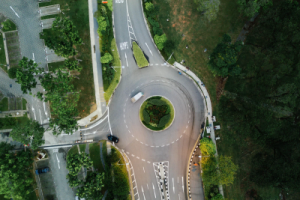
The applications of geospatial data are expanding beyond its original use for mapping. With mandates for government agencies to become increasingly data-driven, the ability to tie location data into planning has become a valuable asset. Integrating geospatial data into planning and operations helps agencies meet broad goals of efficiency, transparency, and preparedness.
Government Efficiency
Utilizing geospatial technology in conjunction with Internet of Things (IoT) sensors and cameras, agencies can automate field inspections. This means capturing changes in infrastructure (a crack in a bridge support, a building constructed without a permit, a leak in a water line) and passing on important information to the people who inspect and fix these assets. While a traditional on-site inspection can take 30-50 minutes (not counting travel time), If the bulk of the assessment is completed before arriving onsite, inspectors can spend less time there, examining only the captured changes or most critical elements of the assessment.
Geospatial technology is also crucial to building digital twins: virtual models of the real world that are used for city planning. With these digital twins, planners can test how changes to the environment--a new building, a clearing of trees, a change to traffic light timing--might impact the community at large. In fact, Peachtree Corners, Georgia built a digital twin of its downtown to include streetlights, trees, buildings, and other infrastructure. Planners there can use live-sensor feeds, traffic analytics, weather data, and AI to experiment with changes and make decisions about how the city can be improved.
Government Transparency
A bill introduced in the Senate would require agencies to provide geospatial data on federal waterways to help recreational anglers and boaters comply with complex regulations on allowed activities. This bill, the MAPOceans Act, would "provide for the standardization, publication and accessibility of data relating to public outdoor recreational use of federal waterways." It would require the Commerce Department to make relevant geographic information system (GIS) data on federal waterways available on an online platform for public use. This would include navigation information, bathymetric data, and depth charts to help people better understand environments and why restrictions may (or may not) be in place.
Managing assets and services in GIS applications can provide new insight into the status of equipment and response teams during crises caused by natural disasters. Adding in location data helps operation teams find assets in the field and understand proximity to critical infrastructure. Then they can deploy the closest, best equipped response teams. These capabilities also enable agencies to share response status (e.g., where an ambulance is, or how soon a snow plough might be expected) with citizens requesting services.
Government Preparedness
Geospatial images and AI can provide important insights that save the lives of first responders and citizens during disaster response. Using AI to analyze real-time data against historical data allows responders to quickly compare before-and-after images to prioritize their response efforts.
On the level of national defense, geospatial imagery and data greatly improve the reality of training-simulation scenarios. For example, in Unmanned Aerial Vehicles (UAVs) and aircraft training, using real geospatial data helps trainees understand how equipment will fly, as well as what sensors are available to them on the aircraft. Real-world examples of threats, from weather to opponents, can also be dropped into those simulations.
For more examples of how geospatial technology is being used across government, check out these resources:
- Geospatial AI Summit (October 7, 2025; Reston, VA) - Learn how cutting-edge AI tools are being used today for physical risk assessment, asset management, and natural disaster support. Hear directly from customers and geospatial experts on what's working in the field--and what's next.
- On the Road (November 13, 2025; Arlington, VA) - This event brings together decision-makers, mission operators, scientists, and technology innovators across the U.S. Department of Defense, civil agencies, and states to examine how emerging geospatial capabilities are reshaping operational strategies.
- GEOINT 2026 Symposium (May 3-6, 2026; Aurora, CO) - The largest annual gathering of geospatial intelligence professionals in the nation, this symposium will delve into the critical role of geospatial intelligence in building a secure future.
- Finding Efficiency with Geospatial Technology (white paper) - Geospatial technology, supercharged by AI, is revolutionizing how governments operate--from improving disaster response to optimizing infrastructure and identifying untapped revenue sources.
- Using AI-Powered Location Intelligence, State and Local Governments Can Build a Sustainable Future (white paper) - AI-powered location intelligence is transforming how state and local governments plan, respond, and build for the future. With frequent high-resolution aerial imagery and 130+ AI feature layers, agencies can create digital twins, detect infrastructure vulnerabilities, and enhance emergency preparedness.
- Digital Infrastructure for World-Class Geospatial Intelligence (white paper) - By integrating AI/ML-ready platforms, secure edge services, and a unified hybrid-cloud approach, agencies can accelerate data delivery, manage unstructured data, and enhance situational awareness at scale.
For more information on geospatial technology applications, search for additional events and resources on GovEvents and GovWhitePapers.