Horizon3.ai

Events We Are Sponsoring

All of DFIR. One Event.
Digital Forensics | Incident Response | Ransomware | Threat Hunting
The SANS DFIR Summit & Training is back—in a new city, a new season, and with our most in-depth program yet.
This year, the Summit has expanded to tackle today’s most challenging DFIR topics—from core digital forensics and incident response to focused deep dives in threat hunting and ransomware—through expert-led talks, open-source tool sessions, and more hands-on opportunities than ever before.
If staying sharp on the latest research, tools, and investigative tradecraft matters to you, this is where you need to be.
Summit: Oct 15-16 | Training: Oct 17-22

SANS 2026 DFIR Summit Solutions Track delivers a deep technical exploration of the tools, methodologies, and operational models driving next-generation digital forensics and incident response. Sessions focus on advanced evidence acquisition, host and network artifact analysis, memory forensics, cloud-native IR workflows, and the application of machine learning to accelerate triage and attribution.
Attendees will learn how to operationalize automation, standardize investigative pipelines, and integrate DFIR technologies into high-scale, distributed environments to improve precision, reduce dwell time, and harden enterprise response capabilities.
What to Expect
- Technical walkthroughs of emerging DFIR tooling—including endpoint telemetry pipelines, memory forensics frameworks, malware analysis sandboxes, and automated evidence extraction workflows.
- Deep-dive case studies detailing attacker tradecraft, artifact correlation strategies, cross-host timeline reconstruction, and cloud IR techniques across AWS, Azure, and GCP.
- Practical guidance and reference architectures for building scalable DFIR environments with automated triage, standardized enrichment, and integrated SOAR/EDR workflows.
Who Should Attend
- DFIR practitioners, digital forensic examiners, threat hunters, and reverse engineers seeking advanced, tool-focused investigative techniques.
- Incident response leads and SOC engineers responsible for building automated triage pipelines, forensic readiness strategies, and high-throughput investigation environments.
- Security architects and platform engineers integrating DFIR telemetry, EDR/XDR data, and cloud-native artifacts into centralized analysis and response systems.
- Organizations evaluating next-gen DFIR platforms, scaling IR operations, or adopting automation and ML-driven investigative workflows.

This AFCEA Solutions webinar will explore how autonomous penetration testing and Continuous Threat Exposure Management (CTEM) help agencies move beyond compliance checklists to evidence-based cyber resilience. The discussion will highlight how organizations can continuously identify exploitable attack paths, prioritize remediation, validate security controls and measure improvements over time using an attacker's perspective.
Attendees will learn:
- Why vulnerability management alone is no longer sufficient against modern threats.
- How autonomous pentesting exposes real-world attack paths that scanners miss.
- How CTEM initiatives align with federal cyber strategies and zero trust goals.
- How agencies can continuously validate remediation efforts and security controls.
- Best practices for measuring cyber resilience through evidence-based security testing.
- Lessons learned from government and DIB security programs leveraging continuous testing.

- Mythos's impact on federal cybersecurity programs.
- How AI accelerates vulnerability discovery and exploitation.
- Why vulnerability counts and severity scores fail to represent mission risk.
- How attackers chain vulnerabilities, identities, and misconfigurations.
- Why exploitability validation is critical for prioritization and decision making.
- How continuous security validation supports zero trust and cyber resilience.
CISA's Binding Operational Directive (BOD) 26-04 represents an important evolution in how federal agencies approach vulnerability remediation.
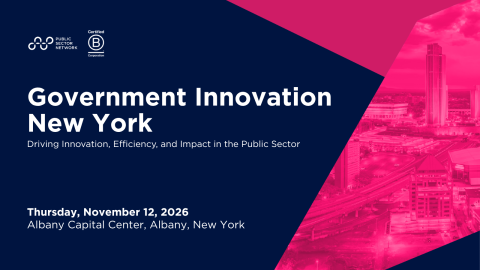
New York State is reimagining how government delivers services. With a historic $1.05 billion technology investment, the state is advancing infrastructure, embedding responsible AI, and strengthening cybersecurity to meet rising constituent expectations. From the new Empire AI Consortium to $90 million for IT upgrades, leaders are building toward integrated, anticipatory service models that reflect practical steps on the path to Government 3.0—delivering joined-up outcomes, stronger public trust, and measurable results for all New Yorkers. As 26% of the workforce retires by 2029, agencies are prioritizing next-generation talent with $56.5 million invested in upskilling and collaboration.
Government Innovation New York convenes senior public sector leaders in Albany to explore proven strategies, share what's working, and accelerate progress with confidence. The program features deep dives on responsible AI adoption, transparent procurement, and future-ready IT, with tracks covering Data & AI Modernization, Digital Services, public cloud security, and human-centered design. Attendees will gain actionable insights through keynotes by state leaders, interactive roundtables, and global perspectives—bridging strategy and implementation. Join fellow innovators for this complimentary full-day event to collaborate, exchange best practices, and leave equipped with frameworks you can apply immediately to shape New York's digital future.