FEDINSIDER

Upcoming FEDINSIDER Events

In the public sector, a security incident is more than a technical hurdle; it is a test of organizational resilience and community confidence. While many local governments operate in a state of reactive defense, the most resilient municipalities are shifting their strategy to treat identity as the new perimeter.
Many local governments face the same hurdles: complex legacy systems, lean IT teams and the constant threat of data breaches. This webinar provides a blueprint for leadership to move beyond “fixing what’s broken” and start building a proactive defense that safeguards both employee and citizen data.
Learning Objectives:
- Outline the strategic decision-making process behind providing a unified identity layer
- Delineate ways that municipalities can scale security expertise rapidly without the overhead of a massive internal team
- Develop practical metrics to measure improved security performance
- List practical steps for using identity management as a shield against future threats, ensuring long-term stability and public trust
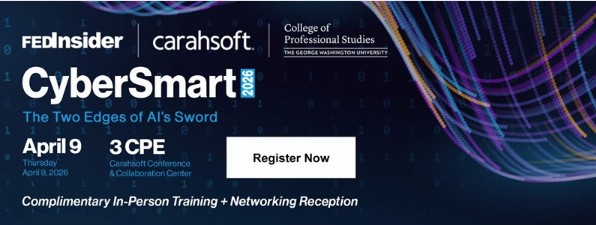
Cybersecurity is always a volatile topic - new threats, new approaches to defense, emerging new attack surfaces. The emergence of AI as a commercially viable technology introduces new considerations, including growing recognition that it substantially increases the need for risk management.
Join FedInsider and Carahsoft in Reston, Virginia on April 9th as thought leaders from government and industry discuss what is happening now, and what threats and opportunities may arise from current trends.

Cybersecurity is always a volatile topic – new threats, new approaches to defense, emerging new attack surfaces. The emergence of AI as a commercially viable technology introduces new considerations, including growing recognition that it substantially increases the need for risk management.
Join us as thought leaders from government and industry discuss what is happening now, and what threats and opportunities may arise from current trends.
Learning Objectives:
- Identify where new AI tools can reinforce existing cyber defenses
- Examine how to protect data privacy within an AI-enabled system
- Evaluate your software supply chain to determine how and where to implement zero trust requirements
- Delineate the elements of a universally applied ZT architecture, including identities, accounts, assets, resources, authentication, behavior, and data
- Review your agency’s operations to locate where OT is used and conduct risk assessments to determine corrective measures

Federal agencies across the board are facing rapidly multiplying security threats, from nation states to criminals. Today's security operations centers (SOCs) are facing a barrage of "more." More attacks. More security tools. More devices and data. To eliminate current threats and anticipate future ones, your SOC must evolve, and fast.
There are numerous mandates directing elements of cybersecurity policies and practices, such as Executive Order 14028 requiring Zero Trust architectures for agencies’ networks and software supply chain integrity, NIST standards for post-quantum cryptography and AI use, and FedRAMP 20x. All the mandates aim for the same result: cybersecurity in real time, continuous and dynamic monitoring, and the ability to tie different systems together.
Join us as thought leaders from government and industry discuss the challenges involved in modernizing SOCs.
Discussion topics include:
- Streamlining security tools
- Minimizing alerts and prioritizing critical actions
- Reducing threat containment time
- Real-world solutions from cyber experts

Federal agencies are under relentless pressure to modernize their security posture as they face an onslaught of new, enhanced threats – from hostile nation-states, criminal networks, and hackers determined to stir up trouble.
The path forward starts with three proven principles: Least Privilege Access, which blocks users from gaining entry to data and software they are not allowed to use; Zero Trust architectures, designed to “never trust, always identify;” and microsegmentation, which allows networks to be blockaded into very small sections that can be walled off from the overall network.
Learning Objectives:
- Learn how to align these three strategies with required mandates
- Outline a practical roadmap for implementation across your agency’s infrastructure
- Delineate the ways these approaches strengthen your agency’s cyber defenses from the inside out

Microsegmentation is a critical security strategy for state and local law enforcement agencies aiming to comply with the FBI’s Criminal Justice Information Services (CJIS) Security Policy. This policy mandates strict security, encryption, and access controls for protecting sensitive Criminal Justice Information (CJI).
The security policy ensures that law enforcement agencies and their partners securely manage biometric, biographical, and case data throughout its lifecycle. Microsegmentation helps meet stringent requirements for controlling access to Criminal Justice Information (CJI) by breaking networks into small, secure zones to restrict lateral movement of threats. Key aspects of microsegmentation for CJIS compliance include limiting “east-west” movement between systems; implementing Zero Trust architectures; and automating the classification of protected assets and creating dynamic security policies.
Learning Objectives:
- Understand the connection between microsegmentation and zero trust architecture in protecting and monitoring “need-to-know” access to CJI
- Evaluate how automated policy generation protects both compliance and operational stability
- Define the role of microsegmentation in protecting high-value assets, such as database servers containing sensitive information such as biographic, biometric, or case report data

Almost all (95%) government agency leaders at all levels say they plan to invest in emerging technologies over the next five years, including generative AI (35%), yet only a fraction achieve measurable and sustainable service improvements.
Part of the challenge is reexamining the metrics used to track improvements in customer service (CX); after all, what is measured should change depending on whether government customers are being assisted by human agents or agentic agents.
Learning Objectives:
- Develop actionable strategies for leveraging analytics and advanced technology integration
- Translate digital initiatives into sustained improvements in stakeholder engagement, transparency, and service reliability
- Navigate legislative mandates and rapidly changing policies with confidence, aligning program delivery with measurable agency goals

City and county governments across the country are facing tighter budgets. Accompanying the financial pressures, these smaller government entities are facing rising service demands and trying to cope with chronic staffing shortages. In this turbulent landscape, agentic AI offers a way to improve services, cut legacy IT debt, and provide assistance to overwhelmed employees.
Counties and cities already use AI to improve public safety, optimize urban planning and transportation, and streamline internal operations. Using pilot programs, they can experiment with AI-generated public agents to identify constituent-facing solutions and scale them as needed.
Learning Objectives:
- Establish priorities for areas of immediate attention for agentic AI pilot programs
- Evaluate the steps to set up an AI public agent program, including the metrics to measure both cost savings and user outcomes
- Explore strategies for connecting key data sources and removing barriers that may prevent your public agent from serving residents comprehensively

Learning Objectives:
- Identify the types of cyber threats your agency is facing and which AI tools are best suited to respond to them
- Delineate which cybersecurity activities can be adapted quickly for AI enablement (e.g., fraud detection through real-time transaction monitoring, phishing detection by analyzing suspicious email)
- Outline the steps to implement AI tools in order of priority
- Identify ways to incorporate theater MPEs into one overall solution
- Review the roles played by zero trust and ICAM in protecting operations while maintaining speed of execution
- Outline the role of AI in identifying and eliminating cyber threats in a battle space environment
- Identify the assets – from supercomputers to dedicated high-speed wireless networks to scientific disciplines – needed to meet the objectives of the Genesis Mission
- Evaluate the role your agency may play in executing a foundational science research project
- Delineate the internal and external resources required to achieve scientific breakthroughs in multiple disciplinary fields and identify overlaps in capabilities and objectives

Learning Objectives:
- Understand how an agency can set priorities for using AI in cybersecurity, whether through monitoring for phishing, closing gaps and patching existing systems, or monitoring for malware that has been modified
- Outline the steps in implementing AI-enabled tools that can work with existing cyber defenses
- Define metrics that can measure the impact of using AI tools for cybersecurity
- Outline the role of drones, sensors and AI to improve situational awareness for first responders, including GIS mapping to analyze hazard risks and affected populations
- Evaluate how your agency is using systems that provide two-way communications, especially alert systems with geo-targeting capabilities to reach affected areas
- Delineate steps to ensure operational readiness, by testing systems, training first responders, and updating protocols to meet federal, state, and local emergency regulations
- Evaluate the value of a unified dashboard that tracks spending across clouds and allocates costs to teams, projects, and applications
- Delineate the steps to implement automated shutdowns of non-critical environments during off-hours and delete unused resources such as unattached storage volumes or IP addresses
- Outline methods for analyzing resource utilization and allocating underutilized storage and databases

Cybersecurity consistently ranks as state CIOs’ top priority in IT. But resilience – the ability to anticipate, withstand, recover from, and adapt to cyberattacks and disruptions, ensuring critical services continue despite adversity, and moving beyond prevention to focus on rapid response and continuity of operations when breaches inevitably occur – has not received the same kind of attention.
A report in November 2024 focusing on states’ efforts on resilience found that 69% of respondents in the state/local/education (SLED) sector acknowledged that cyber resilience is not a whole-organization priority and a majority of IT governance teams didn’t understand what cyber resilience is.
Learning Objectives:
- Establish a working definition of resilience for your organization
- Understand the complementary roles of cybersecurity and resilience in keeping agency systems operational in the event of a cyber attack
- Evaluate ways to use SIEM and SOAR to strengthen your SOC’s performance

The challenges and issues facing state agencies regarding IT investments and modernization are very similar to those federal agencies are dealing with, but often are compounded because state responsibilities (licensing, inspection, and citizen assistance, to name a few) are that much closer to the customers who need their services.
This three-day event tracks many of the priorities that state CIOs are paying attention to –cybersecurity, resilience, modernization, cloud computing, data management, using AI, and analytics, to name a few.
Learning Objectives:
- Establish a working definition of resilience for your organization
- Understand the complementary roles of cybersecurity and resilience in keeping agency systems operational in the event of a cyber attack
- Evaluate ways to use SIEM and SOAR to strengthen your SOC’s performance
- Outline how using modernization toolkits can speed the delivery of better services to citizens
- Identify the forms of hybrid cloud (such as public bolstered by private cloud) that best suit your agency’s requirements
- Understand the integration of SaaS platforms into your agency’s cloud choices
- Understand how to use data platforms to create governance policies that provide quality data
- Evaluate the use of analytics to drive budgeting and enterprise resource planning (ERP) systems
- Delineate ways that GenAI tools can be used for better forecasting and making data-driven decisions

The National Association of State CIOs (NASCIO) reported in its 2025 State CIO Survey that many states have been providing supplemental funding to their CIO organizations to use on IT modernization and/or innovation. Whether streamlining state DMVs or setting up digital services for courts, agencies are focusing on providing better, more streamlined services to their customers.
Included in these modernization efforts is the continuing embrace of the cloud. All the respondents to the NASCIO survey said they have a multi-cloud strategy; their reasons were many and varied, such as modernizing their applications, optimizing their budgets, and aging (legacy) hardware. CIOs in states with federated governance structures discussed selecting software-as-a-service (SaaS) solutions, with the potential to build on their state’s cloud portfolio.
Learning Objectives:
- Outline how using modernization toolkits can speed the delivery of better services to citizens
- Identify the forms of hybrid cloud (such as public bolstered by private cloud) that best suit your agency’s requirements
- Understand the integration of SaaS platforms into your agency’s cloud choices

State and local governments are concentrating on improving internal operations in order to deliver services more efficiently and cost-effectively. In plain terms, agencies want to simplify the work employees do and the steps constituents must take to receive services.
State-level CIOs are looking to reduce operational friction, leverage technology to automate processes, and streamline bureaucracy for both employees and the public. For instance, agencies are automating repetitive, rules-based tasks, such as digitizing frequently used documents to send and receive; defining principles that minimize the need for citizens to submit the same information multiple times to different agencies; and asking employees for suggestions to remove bottlenecks in their processes.
Learning Objectives:
- Understand your agency’s workflow and where bottlenecks, duplication, and repetitive tasks slow down performance
- Evaluate the customer experience and how to align digital services with their needs, such as consolidating agency-wide digital phone, and in-person experiences to reduce friction
- Delineate metrics that can track performance improvements and employees’ job satisfaction

Public sector organizations are operating in an increasingly complex environment shaped by evolving cyber threats, aging infrastructure, workforce shortages and growing expectations for modern digital services.
AI-driven attacks are expanding the threat landscape while legacy systems and fragmented data make it harder for agencies and institutions to respond quickly. At the same time, constituents, staff and students expect faster, more intuitive services similar to what they experience in the private sector.
To keep pace, government and education organizations are modernizing IT operations, strengthening endpoint security and adopting automation and AI to improve both cybersecurity and service delivery.
The Ivanti Public Sector Summit brings together leaders from federal, defense, state and local government, education and industry to discuss practical strategies for securing endpoints, modernizing IT service management and delivering trusted digital services.
Learning Objectives:
- Explain how modernization initiatives help agencies address evolving cybersecurity threats.
- Evaluate strategies for improving coordination between IT and security teams.
- Identify best practices for securing communications in classified and tactical environments.
- Describe key outcomes of effective vulnerability and patch management programs.
- Assess how AI and automation can improve IT service management and service delivery.