AFCEA Bethesda

Upcoming AFCEA Bethesda Events
AFCEA Bethesda’s Emerging Leaders kick off another exciting program year on Thursday, November 12th, with the return of Fed Talks & Headshots. As the first installment of this year's ProDev series, Fed Talks & Headshots has been intentionally curated to suit all your professional development needs: gain valuable career insights, expand your network, get inspired, and update your professional image!
Fed Talks & Headshots will feature Fed Talk speakers who will provide experiential knowledge and insight on navigating your career, pivoting from failure to opportunity, overcoming obstacles, and appreciating differences. The event will also feature an opportunity to snap new headshots—perfect for updating your LinkedIn profile, company bio, or personal branding.
After the talks, enjoy an engaging networking segment dedicated to connecting with peers, industry leaders, and potential mentors in a relaxed yet buzzing atmosphere.
The ProDev series is committed to encouraging vertical and horizontal professional connections to propel emerging leaders in government and industry to the next phase of their career journeys. We welcome folks from all career levels, fields, and experiences to attend this event and leave with a new professional headshot, career insights, and new or renewed professional connections.
The Intelligent Grid: Mission Autonomy and Resilient Systems with Quantum-Safe, Critical Infrastructure
As quantum computing advances, many critical infrastructure systems worldwide face increased risks. These include internet infrastructure, electrical grids, water management, energy production and distribution, as well as financial, healthcare, and transportation systems. What is needed is a system that can automatically detect and fix problems, make independent decisions, and employ next-generation encryption to stay fully secure from future cyberattacks. This year’s Energy, Infrastructure, and Environment (EIE) Summit will address these urgent issues by exploring how to deploy self-healing architectures and strengthen them with quantum-safe cryptography to ensure long-term, unbreakable infrastructure resilience. As environmental instability and cyber threats grow, critical infrastructure requires more than just predictive software: it needs autonomous adaptability. Agentic AI networks capable of real-time decision-making and decentralized operation are essential. By leveraging multi-agent AI systems, automated load balancing, and secure edge-computing operational technology (OT), federal and defense leaders are creating self-healing microgrids that can quickly reroute power during crises. To that end, the Department of Energy (DOE), Department of War (DoW), and commercial innovators are expanding these agentic systems to safeguard domestic energy grids and strengthen forward-operating bases.
Public sector thought leaders will share how federal agencies respond to and deliver innovative solutions that modernize, secure, scale, and solve energy demands and threats. Topics to be explored will cover:
- Moving beyond predictive software to autonomous AI agents that dynamically reroute power during cyberattacks or extreme weather events.
- Practical timelines and deployment strategies for integrating Post-Quantum Cryptography (PQC) into legacy federal SCADA networks.
- Designing intelligent, self-regulating infrastructure capable of managing the enormous energy demands of federal AI data centers.
- Describe impactful AI use cases that agencies are implementing, including how they prepare their workforce for responsible AI adoption with governance and reporting tools, data analysis platforms, secure enterprise integrations, and context-aware digital assistants to automate and personalize workflows.
Join us for EIE to hear government leaders discuss these and other important priorities and initiatives.
Federal health agencies are entering a period where modernization is defined by integration, not implementation. Cloud environments, AI‑enabled operations, and stronger cyber defenses are becoming core to mission delivery, and the Preview event will explore the shared pressures and priorities shaping that shift. This session sets the tone for the 2027 Health IT Summit by focusing on broad, cross‑agency themes rather than program‑specific details, keeping the door open for a wide range of speakers and perspectives.
Leaders from across the federal health community will discuss how agencies are preparing for federated data environments, expanding the use of generative and agent‑based AI, strengthening supply‑chain‑aware cybersecurity, and improving digital engagement tools that support preventive care. These themes mirror the Summit’s focus on integrating cloud, AI, and cyber capabilities to deliver measurable improvements in patient outcomes.
Key Discussion Areas
- Modernization pressures shaping 2027 priorities
- Federated data environments and secure cloud integration
- AI in clinical and operational workflows
- Cyber resilience across interconnected systems and supply chains
- Digital engagement and the shift toward preventive, data‑driven care
- Where agencies need partnership in 2027
The federal health IT landscape has shifted from basic technology rollouts to active operational integration. Driven by the "Make America Healthy Again" (MAHA) agenda, health IT, artificial intelligence (AI), and resilient cybersecurity are essential technologies supporting preventive wellness, cost reduction, and regulatory reform. However, as agencies consolidate shared services and retire vulnerable legacy systems, securing interconnected environments against third-party supply chain risks is vital for modernizing public health.
To support this massive data consolidation, cloud modernization remains a critical objective. Standard cloud infrastructure cannot provide the compute power or security architecture required for predictive modeling, population-scale genomics, and advanced AI. Federal policy now prioritizes federated data environments with secure, zero-trust networks that let agencies and researchers run complex AI models where the data lives. By eliminating the need to move massive medical records, these cloud environments break down agency silos, protect against unauthorized data exfiltration, and ensure continuous privacy compliance.
Within this infrastructure, generative and agentic AI models are transforming clinical operations by automating documentation and diagnostics. Yet as reliance on AI expands, health systems face aggressive ransomware and cyberattacks targeting operational availability. Federal directives now drive automated, AI-driven defense to protect critical health infrastructure without overtaxing a short-staffed cyber workforce. As a result, health agencies now require real-time threat hunting across all networks and vendor supply chains.
Finally, these secure frameworks converge to boost digital patient engagement, transforming consumer technology into a primary front line against chronic disease. Remote biometric monitors and advanced patient portals empower citizens to manage their health at home under new proactive payment models. Because every connected medical and Internet of Things (IoT) device expands the attack surface, embedding end-to-end encryption and device authentication ensures patient trust while shifting healthcare from reactive treatment to secure, data-driven wellness.
Ultimately, progress will be measured by a system's ability to seamlessly integrate federated cloud capabilities, ethical AI adoption, and resilient cyber defenses to deliver measurable improvements in patient outcomes.
Join us at the 2027 Health IT Summit, January 25–26, as we chart the course toward a healthier, more secure, and connected future.
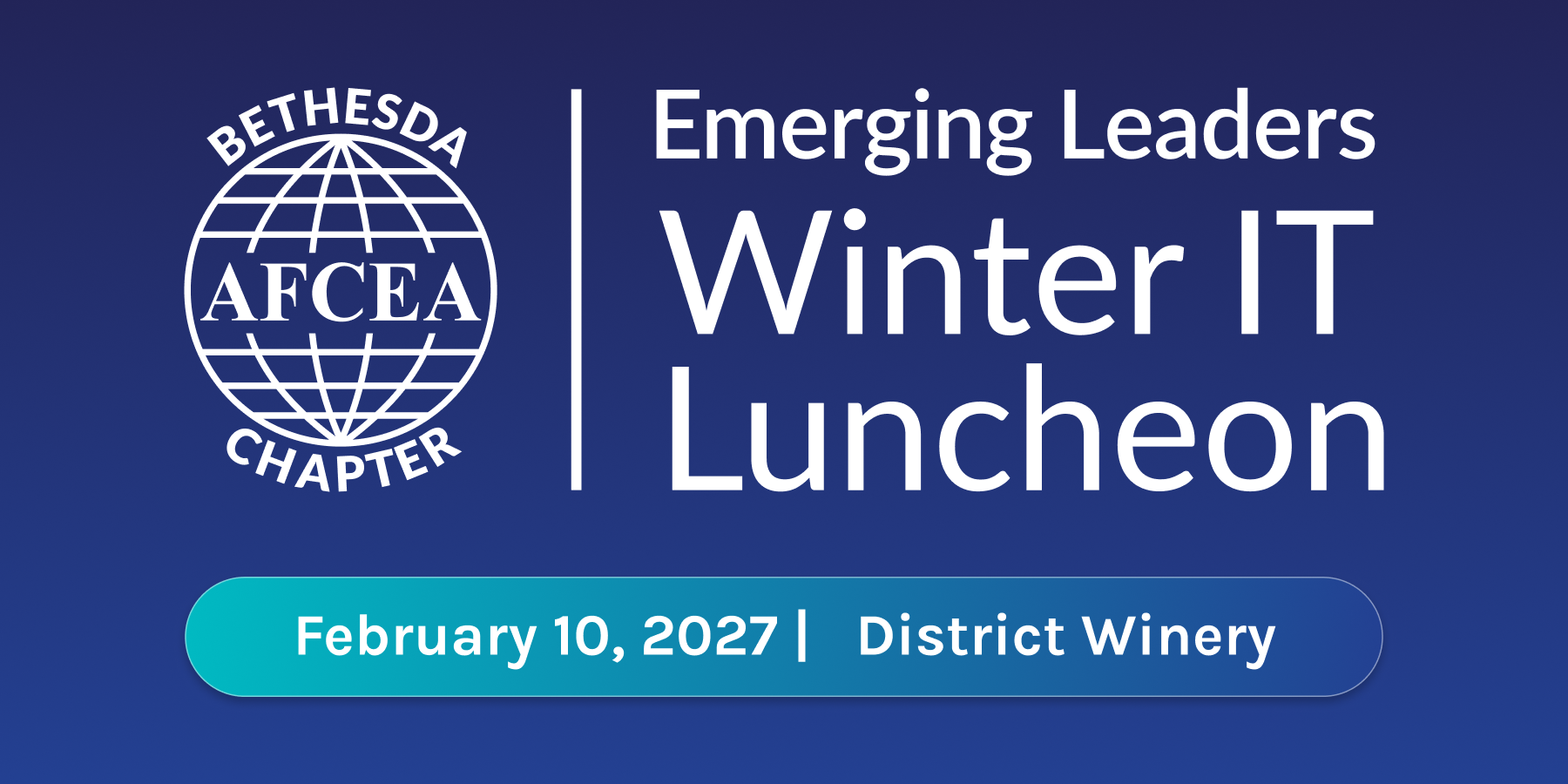
The AFCEA Bethesda Emerging Leaders are excited to host the 15th Annual AFCEA Bethesda Winter IT Luncheon on February 10, 2027, from 11:30 AM – 2:00 PM at District Winery in downtown DC.
This year’s theme is “From AI Experimentation to Mission Impact.” Through candid, small-group discussions led by government leaders, attendees will explore how agencies are moving AI from experimentation to implementation and using it to transform operations, strengthen decision-making, and advance the federal mission.
Roundtable discussions will focus on:
- AI Governance & Guardrails: Establishing strict frameworks and controls to prevent internal and external abuse, ensure safe and authorized responses, and manage costs by preventing token burning.
- AI and Cybersecurity: Securing the AI systems and infrastructure the agency implements, ensuring robust defenses against AI-specific vulnerabilities and threats.
- AI & the Federal Workforce: Ensuring employees securely adopt sanctioned AI tools and effectively leverage them as daily digital assistants to augment their work.
- AI, Data & Decision-Making: Identifying, curating, and managing the highest-quality data foundations necessary to effectively enable and power agency AI models.
- AI Acquisition & Innovation: Transitioning promising AI capabilities out of the pilot phase and successfully deploying them as scalable, enterprise-wide solutions.
The luncheon will bring together senior government officials, emerging leaders, and industry professionals for meaningful dialogue and cross-sector collaboration focused on the practical steps needed to turn AI’s potential into real-world mission impact.