
GovDash

Upcoming GovDash Events
Three eligibility gates are shaping FY27 bids right now, and one just changed. Covered in GovDash's Capturing FY27 report, this session breaks down CMMC's Phase I self-assessment requirement following DOD's suspension of Phase II certification, FedRAMP 20X's accelerated authorization path, and the new OMB mandate requiring AI governance documentation for federal proposals.
What you'll learn
What changed in the CMMC Phase II suspension, and why self-attestation accuracy now matters more than a missed certification
How FedRAMP 20X's accelerated authorization changes the timeline for cloud-native contractors
What the new AI governance documentation requirement means if your team uses AI anywhere in proposal development
How FAR 2.0 shifts the compliance burden toward outcomes, opening the door for non-traditional contractors
Who should attend
Compliance and security officers, contracts and proposal teams, and small business owners in the Defense Industrial Base.

MEGATRON, the Air Force's next major command-and-control IDIQ, is projected to release its RFP in September 2026 with a $4.5B+ ceiling.
It consolidates two vehicles that are no longer taking new vendors, XA and ABMS, under new C3BM leadership. Bryan Guinn, Chief Growth Officer at SBIR Advisors, spends his days moving dual-use and SBIR-funded companies into funded defense programs, and joins Brittany Winkler to break down MEGATRON's seven capability areas, the Small Business Pool structure under consideration, and what separates a firm actually positioned to win from one just tracking the news. Built for capture managers and BD leaders pursuing Air Force digital, battle management, and JADC2-adjacent work.
What You'll Learn
What MEGATRON actually covers across its seven capability areas, in plain terms
What happens to firms currently on the ABMS and XA IDIQs this vehicle succeeds
Bryan's read on the Small Business Pool structure, and what it means for dual-use and SBIR-funded companies without prime experience
How to read the projected timeline, RFP in September and award in October 2027, into a realistic capture plan
What separates a firm actually positioned to win from one that's just tracking the news
Where teaming makes sense across MEGATRON's seven capability areas, and how to identify the right partners before the RFP drops
Who Should Attend
Firms with existing ABMS or XA IDIQ positions evaluating their MEGATRON strategy
Dual-use and SBIR-funded companies with no prime experience assessing whether the Small Business Pool is their entry point
Firms pursuing Air Force digital, JADC2, or battle management work for the first time
Capture managers building a pursuit plan ahead of the projected September RFP
BD leaders assessing where MEGATRON fits in FY27 pipeline priorities

A price that wins has to survive three tests. It has to be competitive against the field. It has to trace back to a documented basis of estimate. And the proposal team has to understand the rationale well enough to write to it.
Evan Allgair walks through what each of those looks like in practice: how to structure a work breakdown that holds up under scrutiny, how to allocate labor so the estimate is auditable, and how to get pricing out of a silo so capture, proposal, and pricing work from the same numbers.
The last five minutes cover how GovDash Pricer handles this work end to end.
What You'll Learn
How to price competitively without guessing at the field
How to make every number traceable to a basis of estimate
How to break the pricing silo so the full team understands the rationale
How GovDash Pricer connects work breakdown, labor allocation, and basis-of-estimate documentation in one workflow
Who Should Attend
Pricing and cost analysts building the basis of estimate for competitive bids
Proposal managers who need the cost volume to match the technical narrative
Capture leads coordinating pricing strategy across a pursuit team
Save your Seat for October 7.

FY26 OASIS+ task order data is in, and small businesses are outperforming assumptions.
On-ramp requirements have proven rigorous enough that the specialists tracking the vehicle describe small businesses as alive and well on OASIS+. In this session, Katie Helwig (President and Co-Founder, Mild Red LLC), Eric Nusbaum (Founder & CEO, ENcompass Consulting Group), and Dan Abernathy (CGO & SVP, ENcompass Consulting Group) join Brittany Winkler to walk through insider vehicle activity data most firms cannot access on their own: who won in FY26, which domains saw the most award volume, and what the results mean for firms preparing an FY27 on-ramp or repositioning move. Built for capture managers, BD leaders, and any firm evaluating its position on or off OASIS+.
What You'll Learn
How to read OASIS+ landscape data (buyers, domains, spend volume) the way insiders do, not the way it gets reported publicly
What the FY26 results actually show across domains: who bought, how much, and where the volume went
Why small businesses are winning real task orders on OASIS+, and what that maturity signal means for your own position
The on-ramp and repositioning moves FY27 actually demands, whether you're on OASIS+ today or not
The specific moves Katie, Eric, and Dan are recommending to their own clients right now
Who Should Attend
Small and mid-tier professional services firms competing for OASIS+ task orders
BD leaders building a long-term GWAC strategy
Firms not yet on OASIS+ weighing their FY27 entry point
Capture managers and executives deciding where to prioritize FY27 pipeline investment

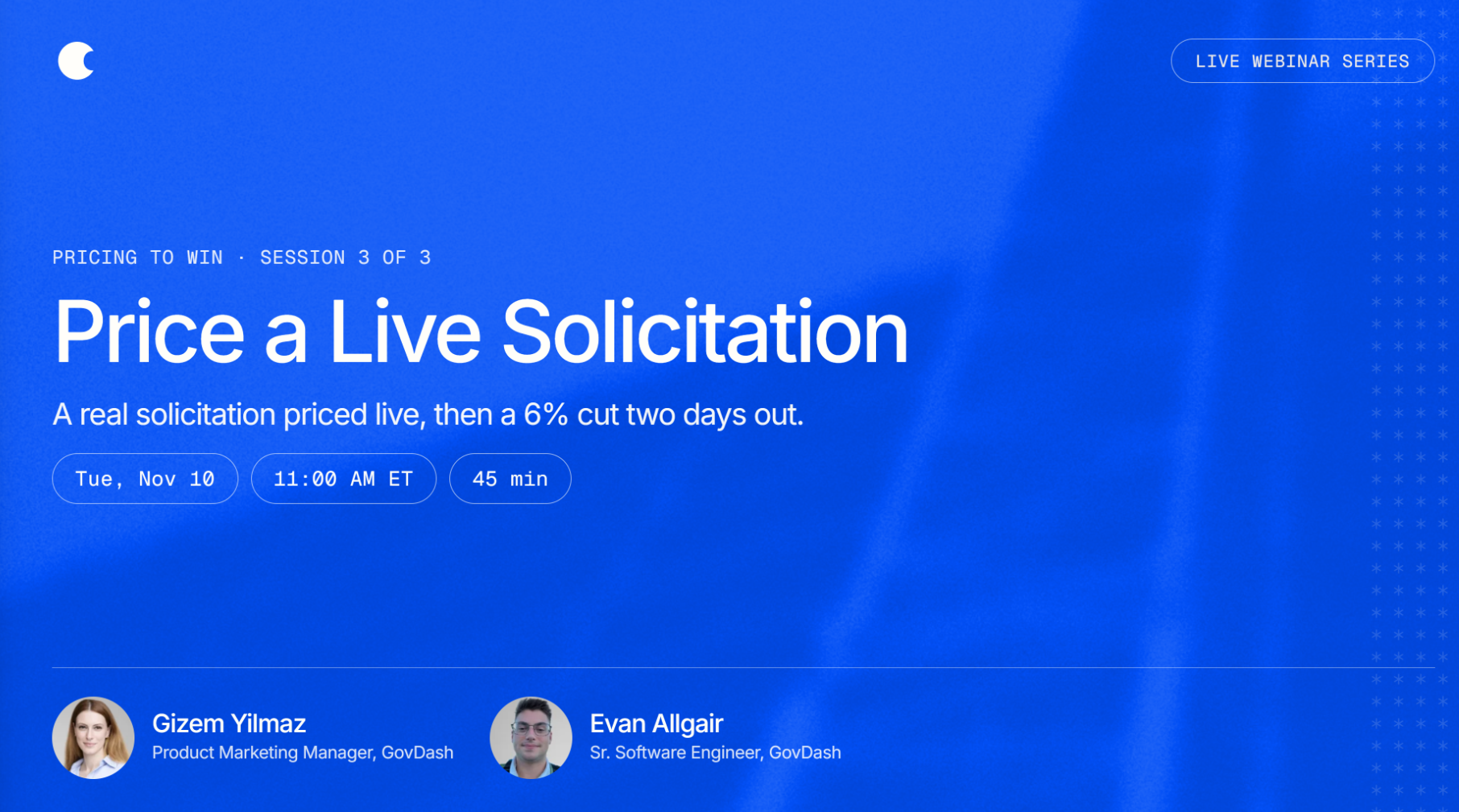
We are building a price on screen, start to finish, against a real solicitation.
Evan Allgair takes a live solicitation and works through the full path: work breakdown structure, labor hour allocation, cost element handling, and basis-of-estimate documentation, ending with a cost volume ready for review. You will see how GovDash Pricer pulls context from the rest of your pursuit so the price reflects the capture strategy instead of sitting apart from it.
Twenty minutes of the hour is a full Pricer demo. Bring questions about your own pricing process.
What You'll Learn
How to set a competitive target price before you start building
How to structure work breakdown, labor allocation, and cost elements inside GovDash Pricer
What documentation holds up in a price reasonableness review
How GovDash Pricer ties the cost volume back to the capture strategy
Who Should Attend
Pricing and cost analysts who want a live walkthrough of the full pricing workflow
Proposal and capture teams evaluating GovDash Pricer for an active pursuit
GovCon leaders who want to see the platform their pricing team would actually use
Save your seat for November 10.
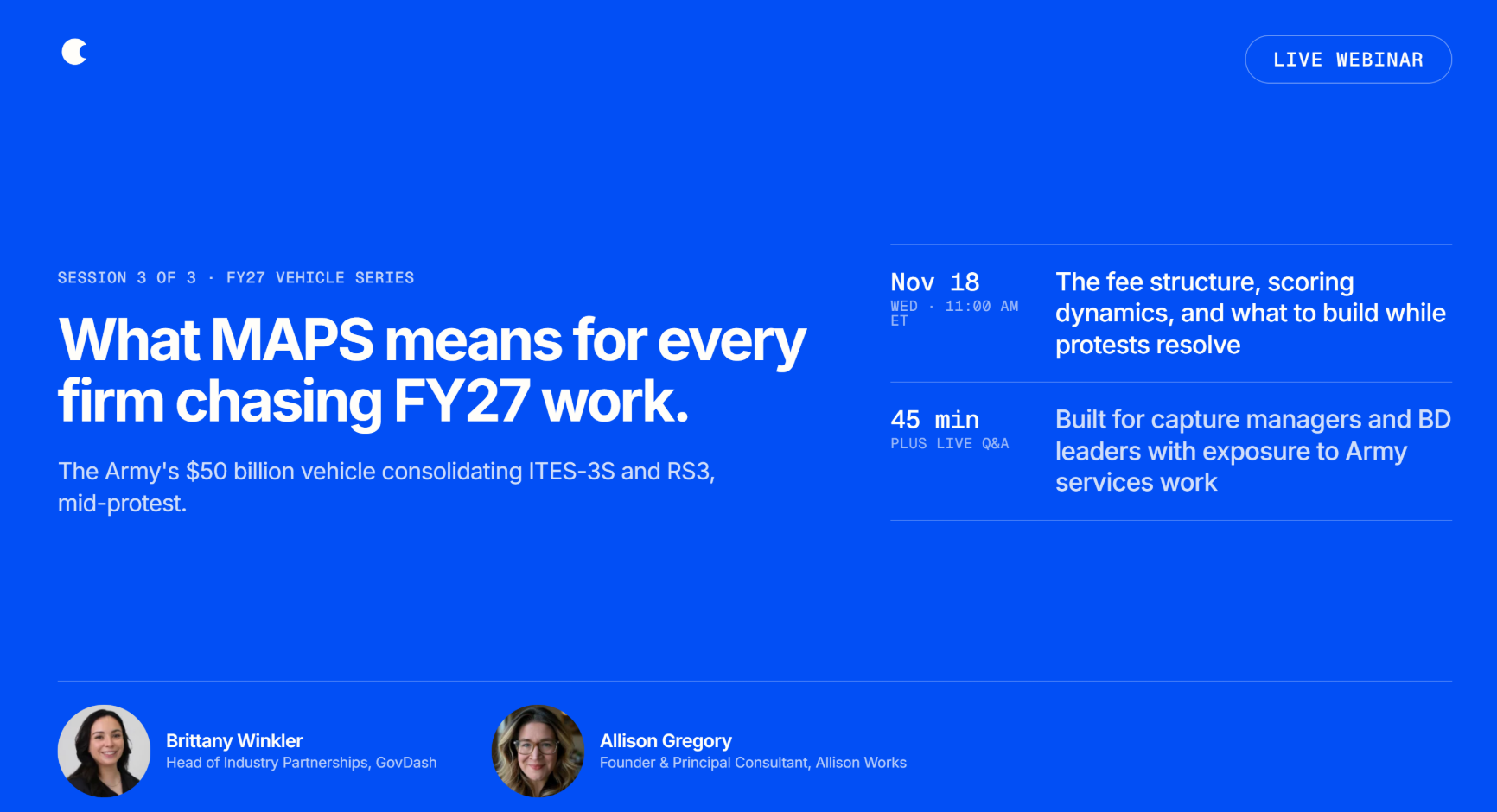
MAPS, the Army's $50 billion vehicle consolidating ITES-3S and RS3, is in the midst of protests.
GAO has already sustained one challenge and ordered the Army to reopen the solicitation, with six more protests pending through September and October. Allison Gregory spent over a decade inside Army Contracting Command, including a developmental assignment in the DASA(P) office, before moving to the private sector at the end of 2025. Allison is tracking a cost-and-scoring dynamic most bidders don't see: a contractor-paid access fee at 1 to 1.5%, a self-scoring system Allison estimates at roughly 127,000 points, and a gap where Air Force and first-time Army primes can outscore vendors with deep RS3 or ITES-3S history.
Allison and Brittany break down where MAPS stands post-ruling, what it means for firms transitioning off ITES-3S and RS3, and what to build while the remaining protests resolve. Built for capture managers, BD leaders, and any firm with exposure to Army services work heading into FY27.
What You'll Learn
Where MAPS stands after GAO's sustained protest and court-ordered reopening, and what the September/October timeline means for FY27 planning
How the contract access fee structure shaped the Army's approach to this vehicle
The scoring mechanics behind the roughly 127,000-point estimate, and where firms tend to over-score against what CPARS will actually support
Why Army contracting officers are trained to challenge any CPARS rating above Satisfactory, and what that means for your past performance narrative
The scoring gap between Air Force and first-time Army primes versus firms with deep RS3 or ITES-3S history, and what the Army has and hasn't done about it
What to build now while the remaining protests are pending
Who Should Attend
Firms transitioning off ITES-3S or RS3 with exposure to Army services work
Capture managers preparing MAPS proposals or evaluating a future recompete
BD leaders assessing FY27 pipeline risk tied to pending GAO protests
Executives deciding how much to invest in an Army-specific growth strategy