George Washington University (GWU)
Events We Are Sponsoring
Federal agencies have largely moved beyond asking whether AI works. The challenge now is determining how to deploy the right AI capabilities in the right places to accelerate mission outcomes while navigating the realities of procurement, governance, workforce readiness, and operational complexity.
New research reveals that while agencies are confident in AI’s potential, many still face significant delays moving from pilot to production and struggle to measure success beyond technical implementation. The primary bottleneck is rarely the AI model itself; rather, it is fragmented data infrastructures, misaligned organizational workflows, and a lack of rigorous, enterprise-grade governance. For instance, pilots often use small, immaculately cleaned, and curated datasets. In contrast, live production environments contain messy, fragmented, and siloed data across legacy systems. When models hit this noisy real-world data, accuracy plummets.
Learning Objectives:
- Identify the differences between a pilot program environment and the real-world environment the pilot program is supposed to scale to
- Review the workflow used by the pilot and compare to the workflow of users not participating in the pilot to find where there are snags and obstacles
- Evaluate the requirements for investing in machine learning operations, security, compliance testing, and scaling compute costs – necessary for budgeting, planning, and timeline management
Cyber attacks and data breaches are on the rise and continue to pose serious threats to our digital economy. Many are aware of cyber threats from human sources, but not many are talking about the security threat posed with unmanaged autonomous AI agents.
In response, state and local agencies are looking to
incorporate controls for AI into their cybersecurity measures.
According to the Code for America assessment, almost all 50 states have initiated pilot programs for a wide range of programs, with leaders like New Jersey and Pennsylvania operating AI at scale. But those governments continue to grapple with legacy system modernization and data cleanup, which are critical to ensure AI tools function securely and accurately without exposing siloed information.
Join us as thought leaders from government and industry share their insights in confronting AI-powered threats by seeking to harness AI tools into their existing and future cybersecurity programs.
Learning Objectives:
- Understand the nature of the cyber threats your agency faces and which ones are using AI to find weaknesses
- Review the steps to take a pilot project and replicate it at scale across your agency
- Evaluate your legacy system modernization and data cleanup programs to identify where AI tools can streamline processes and cut costs
- Outline the ways other state and local agencies have addressed these challenges
Public sector organizations are operating in an increasingly complex environment shaped by evolving cyber threats, aging infrastructure, workforce shortages and growing expectations for modern digital services.
AI-driven attacks are expanding the threat landscape while legacy systems and fragmented data make it harder for agencies and institutions to respond quickly. At the same time, constituents, staff and students expect faster, more intuitive services similar to what they experience in the private sector.
To keep pace, government and education organizations are modernizing IT operations, strengthening endpoint security and adopting automation and AI to improve both cybersecurity and service delivery.
The Ivanti Public Sector Summit brings together leaders from federal, defense, state and local government, education and industry to discuss practical strategies for securing endpoints, modernizing IT service management and delivering trusted digital services.
Learning Objectives:
- Explain how modernization initiatives help agencies address evolving cybersecurity threats.
- Evaluate strategies for improving coordination between IT and security teams.
- Identify best practices for securing communications in classified and tactical environments.
- Describe key outcomes of effective vulnerability and patch management programs.
- Assess how AI and automation can improve IT service management and service delivery.
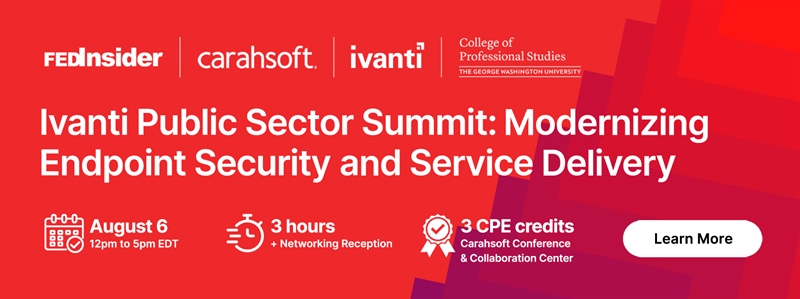
Ivanti, Carahsoft and FedInsider are bringing together government and education IT and security leaders for the 2026 Ivanti Public Sector Summit, an in-person event focused on strategies and technologies to help modernize IT operations and strengthen cybersecurity across the public sector. Across government and education, organizations are navigating increasingly complex IT environments while supporting hybrid workforces, expanding digital services and defending against evolving cyber threats. This summit will bring together leaders from federal, state, local, defense and education sectors to share practical approaches for improving visibility, reducing operational burden and delivering secure, reliable technology services. |
Join your peers and industry experts for an afternoon of insightful discussions, fresh perspectives and real-world experiences. |
As agencies move to implement AI throughout their organizations, most are finding their AI efforts disrupted by fragmented, low-quality, or inaccessible data. This is a problem government shares with the private sector – a recent survey found that 79% of respondents said their AI initiatives are being hindered by limited access to data across environments.
These are not new problems for the government. There are still issues with data fragmentation and silos, poor data quality, complexities in applying governance and security requirements, and technical debt – legacy systems aren’t designed for modern analytics needs. And. of course, the pace of data generation continues to accelerate, adding to the pressure to clean and restructure massive numbers of datasets. That recent survey found that 60% of AI projects may be abandoned due to poor data readiness.
Learning Objectives:
- Outline the particular challenges in data readiness faced by your agency
- Delineate the steps to address those challenges, including prioritization and resource allocation
- Establish metrics to measure improvements in data quality so your agency datasets can be used by AI tools to produce trusted solutions

There is widespread recognition in federal agencies that they face increasingly sophisticated AI-driven threats. At the same time, agencies must also contend with evolving compliance mandates and shrinking budgets.
To simultaneously protect missions, ensure compliance, and align with federal efficiency and budget goals, agencies need to adopt modern, compliance-aligned endpoint detection and response (EDR) security strategies that enable full, real-time endpoint visibility while reducing false positives and preventing cost creep.
State and local agencies are exploring how to incorporate artificial intelligence (AI) into their operations – as long as they observe their own state-level and any applicable federal-level regulations.
To meet these requirements, AI governance and compliance platforms help organizations manage, monitor, and enforce policies for safe, ethical, and legal use of AI, covering the entire lifecycle from development to deployment, by automating risk assessment, bias detection, and access control. These platforms centralize control, provide transparency, track data lineage, and automate auditing to build trust and prevent issues like unfair outcomes or data breaches.
Learning Objectives:
- Outline the capabilities of AI management and compliance platforms and match them to the needs of your agency
- Delineate the use of the platforms to maintain auditability and traceability
- Understand how these platforms can guard against “shadow AI,” unauthorized use of AI within the agency
Join us as thought leaders from government and industry share their expertise, their experiences, and their suggestions for harnessing the power of AI to provide noticeable improvements to internal operations while improving security and opening up opportunities for new and expanded services to their constituencies.
Agencies throughout state, local, territorial, and tribal governments are being encouraged to incorporate artificial intelligence (AI) into their everyday operations, to streamline processes, modernize outdated systems, and strengthen cybersecurity defenses. Using AI is viewed as one promising way to deal with shrinking budgets and increased demand for services by citizens.
This three-day event addresses key issues that agencies must contend with in ensuring that investment in AI generates maximum benefit.
Learning Objectives:
- Outline the capabilities of AI management and compliance platforms and match them to the needs of your agency
- Delineate the use of the platforms to maintain auditability and traceability
- Understand how these platforms can guard against “shadow AI,” unauthorized use of AI within the agency
- Identify available AI tools to determine which best fit the security needs of your agency
- Review ways to integrate AI cybersecurity into existing defenses
- Understand the nature and magnitude of the threats posed by AI-empowered attacks
- Delineate places in your agency’s IT systems where AI can serve as a bridge between legacy systems and new services for citizens
- Establish priorities for tasks and processes that can be streamlined through the use of AI tools
- Outline metrics that can measure improvements, such as improved accuracy in testing, cost savings through reductions in outside labor costs (such as coding), and faster turnaround time in updating apps
It is widely recognized that the introduction of AI tools is a two-edged sword when it comes to cybersecurity. Attackers, whether profit-driven hackers or hostile nation-states, are using AI to launch faster, wider-spread and more sophisticated attacks, including AI-generated phishing and spear phishing emails, malware capable of adapting to changes in defensive responses, and deepfakes that are very hard to detect.
State and local agencies are attractive targets, since there are many more of them and often do not have the financial or IT resources of federal agencies.
This makes state and local agencies’ use of AI in cyber defense critical – AI tools can operate at machine speed and scale and adapt in response to evolving threats. These tools can significantly improve threat detection and intelligence by identifying anomalies and patterns signaling attacks under way; automating incident responses such as isolating compromised devices and resetting credentials; using Natural Language Processing (NLP) to flag sophisticated phishing and social engineering attacks; and prioritizing vulnerabilities to emphasize the most critical risks.
Learning Objectives:
- Identify available AI tools to determine which best fit the security needs of your agency
- Review ways to integrate AI cybersecurity into existing defenses
- Understand the nature and magnitude of the threats posed by AI-empowered attacks
At its annual conference in October 2025, the National Association of State CIOs (NASCIO) focused on “measurable modernization” facilitated by artificial intelligence (AI). Intelligent, AI-powered tools can streamline IT, converting slow, manual legacy system upgrades into faster, cheaper, and more secure processes by automating code analysis, testing, data migration, and even generating code, ultimately making systems more efficient, scalable, and future-proof while freeing humans for higher-value tasks.
There are several ways AI is suited to improve operations. To name just a few:
- By analyzing legacy code, such as COBOL, to understand its structure, find inefficiencies and even rewrite it into modern coding languages, AI reduces legacy debt and eases manpower needs for obsolete coding skills.
- AI tools can automate testing and quality controls, significantly speeding up quality assurance and moving apps to more easily supported operations.
- Using AI can generate predictive maintenance, identifying potential system failures and enabling self-healing capabilities.
Learning Objectives:
- Delineate places in your agency’s IT systems where AI can serve as a bridge between legacy systems and new services for citizens
- Establish priorities for tasks and processes that can be streamlined through the use of AI tools
- Outline metrics that can measure improvements, such as improved accuracy in testing, cost savings through reductions in outside labor costs (such as coding), and faster turnaround time in updating apps

Military units often operate in austere environments, far from the secure cloud networks and multilayered cyber defenses of a traditional headquarters. Tasked with no-fail missions, these units depend on constant, secure access to their most critical resource: the network. The Zero Trust principle of “never trust, always verify” — controlling who can access what and limiting lateral (east-west) movement between applications — is both Government-mandated and mission-critical.
Identity, Credential, and Access Management (ICAM) provides the foundation for Zero Trust through continuous identity and access verification. In disconnected and air-gapped scenarios (DDIL), missions must still proceed during disruption from weather, terrain, and adversary activity. A robust ICAM solution bridges the gap between high-level enterprise security and the tactical edge by planning for network loss with pre-synchronization and re-synchronization techniques.
Learning Objectives:
- Understand what ICAM is and how it fits within a Zero Trust framework
- Outline how using ICAM and ZT meet and maintain federal mandates
- Evaluate the costs and benefits of maintaining high-level connectivity and security in contested environments
AI introduces new vulnerabilities – such as data leakage, model manipulation, and uncontrolled access – even as agencies are still figuring out how existing risk and security frameworks apply. Recent news articles have reported that Anthropic’s newest AI model, Mythos, found 2,000 vulnerabilities in just seven weeks of testing commercially available software; Mozilla, for instance, reported Mythos identified 271 security vulnerabilities in Firefox 150. There have been instances where security teams are pulled in late and asked to “make it safe” after deployment decisions are already underway.
There are cybersecurity constructs in place that can help control access to AI tools and data. For example, the Zero Trust mandate already in place – “never trust, always verify” – strengthens requirements for access. Having an “identity-first” security structure can minimize the risks associated with AI adoption.
Learning Objectives:
- Identify existing cybersecurity weaknesses in existing processes, such as where security is being bypassed or bolted on too late
- Understand how to apply Zero Trust concepts to AI workflows
- Confirm cybersecurity alignment with guidance provided by the National Institute of Science and Technology (NIST) and the Cybersecurity and Infrastructure Security Agency (CISA)
Major, globally visible events—such as the World Cup or Olympic Games—fundamentally change how cyber-physical risk must be identified and prioritized. Events such as these usually are designated as National Special Security Events (NSSEs), based on factors like national significance, projected attendance, and potential threat levels, with the U.S. Secret Service leading security operations.
Cyber-physical risk is the potential for cyberattacks on networked systems—such as IoT devices, industrial control systems, or medical equipment—to cause real-world damage, including physical injury, environmental catastrophes, or destruction of infrastructure. These risks occur at the intersection of digital, networked software and physical, mechanical processes. NSSEs increase the potential for attacks on such devices as credential readers, environmental control systems (heating, cooling, and water), and hospitals near the events.
Join us as thought leaders from government and industry discuss how organizations can prepare to support a major event by identifying, quantifying, and prioritizing cyber-physical risks pertaining to operational technologies (OT) deployed for the event.
Learning Objectives:
- Understand the distinct risks to OT in major event environments, especially when systems are temporary, shared across public and private owners, or rapidly deployed
- Identify which OT-related threats or vulnerabilities tend to have the most significant downstream or cascading impacts, and which are most often underestimated during planning
- Learn how to assess and model cyber-physical risk across interconnected systems, such as venues, transportation, and broadcast infrastructure
- Delineate what effective integration between cybersecurity, physical security, and operational stakeholders looks like in practice – and where it breaks down most often
After the hard work of assessing cyber-physical risks in advance of National Special Security Events (NSSEs) such as the Olympics or World Cup, the next step is discussing systemic vulnerabilities and planning for blind spots. Every major event runs on a complex, interconnected web of systems, yet the full chain of critical dependencies is rarely mapped and tested.
This session explores complex “what if” scenarios that challenged common assumptions underlying security and resilience planning, with a particular focus on limited visibility into the operational technology (OT) environments connected to IT systems.
Join us as thought leaders from government and industry share how they approach mapping dependencies, looking for unsuspected connections, and work to avoid making assumptions about roles and responsibilities.
Learning Objectives:
- Outline the process for “gaming out” possible scenarios
- Establish methods for decision-making during moments of uncertainty or ambiguity
- Evaluate criteria for partnerships to strengthen responses
- Delineate best practices for developing effective incident response plans at a scale appropriate to the NSSE
Identify where regulatory frameworks may conflict with operational needs