Carahsoft Technology Corp.
Carahsoft has built our reputation as a customer-centric organization dedicated to serving the needs of our technology manufacturers, government end users, and reseller ecosystem with Solutions for Government. We have a proven history of helping government agencies find the best possible technology solution at the best possible value. Each customer works directly with a dedicated account representative to determine a solution tailored specifically to meet his or her needs. We combine our extensive knowledge of the technologies we provide, with a thorough understanding of the government procurement process, to analyze needs, provide configuration support, simplify the ordering process, and offer special government pricing.

Upcoming Carahsoft Technology Corp. Events
Building enterprise solutions for federal missions shouldn't take longer than the threat cycle they're designed to address. But complex data, siloed systems and fragile integrations keep teams stuck in build mode while adversaries move at mission speed. That's not sustainable.
In this session, we'll show how developers can use PDP Xgentic within the Progress Data Platform to rapidly build and deploy mission-ready applications.
By unifying structured and unstructured data with context and governance, the platform enables teams to streamline development, reduce integration overhead and deliver reliable, governed AI solutions — applications that turn complex data into operational intelligence, for any domain, at the speed the mission actually requires.
On July 27, attendees will learn:
- How to simplify application development across federal data environments
- Ways to reduce integration complexity and manual development effort
- How to build scalable, mission-ready applications faster
- Best practices for working with structured and unstructured data
- What to expect from the hands-on workshop experience
Pressures to improve reporting, increase data accessibility, and prepare for AI driven initiatives are growing. Implementing these while still meeting compliance requirements is a challenge for any organization.
Join ibi and Carahsoft for an exclusive in-person forum and networking event designed specifically for public sector leaders and practitioners. Learn how agencies are breaking down data silos, improving operational visibility, and building trusted data foundations that support better decision-making today and AI adoption tomorrow.
What you'll gain:
- Proven approaches to strengthen compliance, improve efficiency, and modernize legacy reporting environments
-
Practical strategies to improve reporting, data access, and operational visibility across departments
-
Best practices for creating a trusted, governed data foundation that supports secure AI initiatives
-
Insights into ibi's product roadmap and how future innovations can support your agency's modernization goals
-
Opportunities to network with peers from agencies across the DMV region
Plus, enjoy complimentary breakfast, lunch, and a post-event Happy Hour while connecting with fellow public sector professionals.
ADA Title II now applies to all digital communications, including email. Email signatures, formatting and disclaimers fall within this scope, and most SLED organizations are not aware that their emails may be noncompliant. With increasing audits and high fines, a straightforward and efficient solution is needed.
Join our complimentary webinar and hear Exclaimer's Chief Account Manager, Andrew McCourt, discuss what ADA Title II and WCAG 2.1 compliance actually requires for email, where government and education organizations are most exposed and how centrally-managed email signatures can quickly close the gap.
Specifically, you will learn:
- Which email elements are most commonly flagged in accessibility audits and why email signatures are a frequent blind spot
- How ADA Title II requirements apply across SLED organizations, from county governments to community colleges and universities
- What compliant email signatures look like, including alt text, formatting standards and legal disclaimers
- How Carahsoft and Exclaimer are helping government and education organizations meet requirements through easy, centralized management available through existing procurement channels
Whether your organizational role is responsible for IT, compliance or both, this session provides a clear picture of where your compliance current stands and the next steps - save your spot today!
AI agents are already running across your enterprise. They are in your cloud environments, vendor platforms and business applications. The question is no longer whether to deploy AI, but whether you can see it, govern it, secure it and automate with it at speed.
This hands-on workshop explores how ServiceNow AI Control Tower serves as the enterprise control and governance plane for every AI system, agent and workflow, regardless of where it runs. Participants will gain practical experience across three interlocking capabilities: AI Control Tower as the enterprise command center that discovers every agent, model and MCP server into a living inventory and eliminates shadow AI; Security Operations powered by AI agents that enforce guardrails, govern digital identities and respond at machine speed; and Intelligent Automation that closes exposure and drives remediation through workflows that act without waiting to be told, eliminating manual overhead across the entire security and risk lifecycle.
Walk away with a mission-ready blueprint grounded in ServiceNow's Australia platform release and the latest announcements from Knowledge 2026 that turns AI ambition into accountable, measurable outcomes your CISO and CFO can both stand behind.
- Why disciplined advisory, not just implementation, unlocks exponential platform value
- How to shift from fragmented projects to coordinated, best-practice-driven strategy
- The specific moves Missouri made to maximize ROI across ITSM, ITOM and PSDS
- Peer-tested tactics you can apply to your own ServiceNow journey starting today
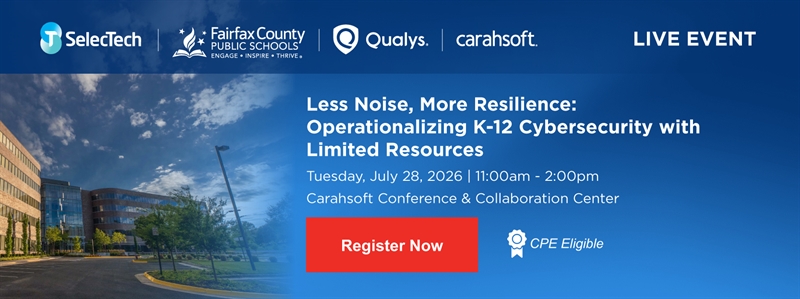
Public school districts have become primary targets for sophisticated cyber exploits, yet K-12 security teams are continually asked to defend expanding digital footprints with constrained budgets and understaffed IT departments. Between massive 1:1 student device initiatives, a surge in third-party EdTech applications, and mounting federal compliance expectations from CISA, managing district-wide risk can feel like an impossible balancing act.
Join Qualys, SelecTech and Fairfax County Public Schools for an interactive lunch and learn designed specifically for K-12 IT Directors, CISOs, and technology leaders. Together, we'll move beyond industry buzzwords and explore practical strategies that help school districts reduce risk, improve visibility, and streamline cybersecurity operations.
Key takeaways from this lunch in learn include:
-
Complete Asset Visibility: How to discover and continuously monitor every device on your network—from student Chromebooks to administrative servers and classroom IoT—without heavy infrastructure deployment.
-
Risk-Based Prioritization: Moving away from endless patch cycles by prioritizing the specific vulnerabilities actively being exploited in the wild (CISA KEVs), saving your team valuable time.
-
Managing the EdTech Attack Surface: Practical approaches to tracking, auditing, and mitigating risk introduced by third-party educational software and cloud platforms.
-
Meeting Compliance & Insurance Baselines: Streamlining your operations to easily align with CISA’s K-12 Performance Goals and satisfy strict cyber insurance renewal requirements.
Come connect with your regional K-12 peers to share real-world strategies for reducing your district's attack surface and building a sustainable culture of cyber resilience.
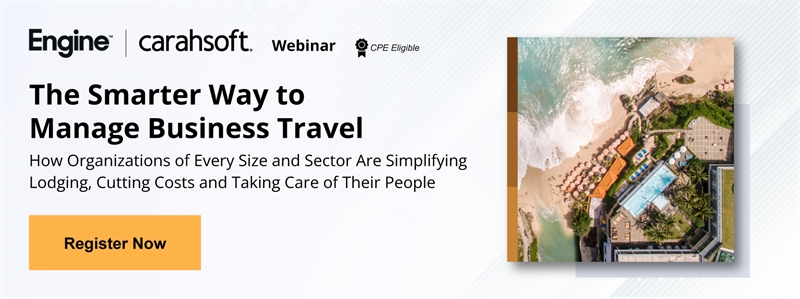
Business travel management is more complex than ever - scattered bookings, lack of visibility and out-of-control lodging spend are challenges that cut across every industry, from government agencies to global enterprises. Most organizations are stitching together spreadsheets, corporate cards and disconnected tools just to keep up, leaving finance teams in the dark and travelers frustrated.
Join this complimentary webinar to learn how Engine changes that by centralizing hotel booking, policy enforcement and spend reporting into one intuitive platform, giving organizations of any size or sector the control and clarity they need without the complexity.
Register now to learn:
- How organizations across government and the private sector are using Engine to consolidate and simplify their travel programs
- The real cost of unmanaged lodging spend and how Engine's pre-negotiated rates and policy controls drive measurable savings
- How to drive traveler adoption without mandates or lengthy onboarding, and why a great user experience is the #1 driver of compliance
- What duty of care looks like in a modern travel platform and how Engine gives you real-time visibility into where your people are
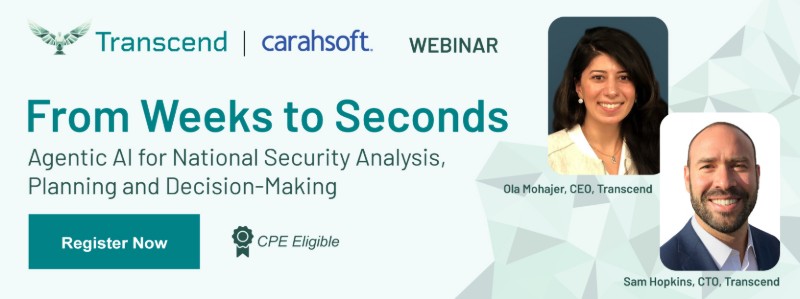
- A live demonstration of a single AI agent built on the same foundation as the first AI agent ever deployed at the United Nations, where 80% of UN professionals expressed adoption intent and reported 30-50% reductions in research and synthesis time.
- How Transcend's DIME network - specialized for diplomatic, informational, military and economic domains - dynamically orchestrates around any problem to deliver integrated analysis in minutes, not weeks.
- Every output traced to an expert-curated knowledge base that you control: how Transcend makes AI analysis fully auditable and trustworthy for high-stakes institutional environments.
- How Transcend compresses analysis cycles that traditionally require costly external studies into rapid outputs your team owns, reducing mission risk and operational spend.
- What agentic AI actually is and why it represents a fundamental shift from the AI tools Government teams are already using.
School districts manage a complex web of vendors, contractors, IT staff, and administrators who need remote access to sensitive systems every day of the school year. When that access is unmanaged, a single compromised account can expose student records, financial data, health information and district operations. Third-party vendor breaches in K-12 rose from 4% in 2023 to 32% in 2025.
Join this session to learn how K-12 districts can apply practical privilege controls across central offices, classrooms, vendors, cloud applications and remote support workflows that support accountability, cyber insurance requirements and FERPA compliance.
What you'll learn:
- Why unmanaged vendor and remote support access is one of the highest-risk exposure points in K-12 environments
- How to replace broad network access with time-bound, approved sessions scoped to specific systems
- How session recording and audit trails support governance, cyber insurance and FERPA requirements
- Practical approaches for lean IT teams to enforce stronger access controls without adding operational burden
- What Mythos changes, and what it does not change
- Why AI-driven vulnerability discovery increases prioritization challenges
- The difference between vulnerable and exploitable risk
- How attackers use attack paths and identity weaknesses
- Practical approaches to improving cyber resilience
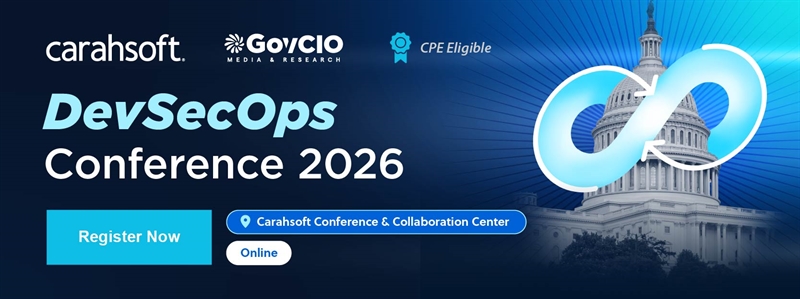
- Government Panels: Hear directly from federal leaders as they unpack the evolving DevSecOps landscape, share real-world mission challenges and compare approaches across agencies.
- Fireside Chats: Explore topics such as AI-enabled DevSecOps, cloud security, and compliance modernization through conversational, panel-style fireside sessions featuring multiple government and industry voices.
- Networking Sessions: Connect with peers, government attendees, and industry experts in relaxed, open networking blocks designed to spark conversation, share lessons learned and build mission-aligned partnerships.
Your Zero Trust controls verify identity, protect endpoints, and enforce access policies. But what happens when a user with valid credentials exploits trust between systems to reach data they should never touch and every control says "allow"?
Join us for a demonstration of insider threat detection and automated response on the AWS Zero Trust Accelerator for Government (ZTAG-I) architecture. In this session, you will watch a realistic attack unfold across six telemetry sources and see how Splunk correlates signals from Okta, CrowdStrike, AWS CloudTrail, VPC Flow Logs, and Windows to surface the complete attack chain and trigger automated containment through Splunk SOAR in seconds.
This is not a slide deck. This session is a demo on AWS GovCloud with real telemetry, real detections, and real automated response.
In this webinar, attendees will see:
- A realistic insider threat scenario where an authenticated user escalates privileges and moves laterally across AWS infrastructure
- How Okta, CrowdStrike, and AWS each detect activity within their domain and how Splunk connects those signals into a single correlated view
- The complete MITRE ATT&CK kill chain mapped in Splunk Cloud with cumulative risk scoring
- Splunk SOAR executing automated containment: endpoint isolation, credential revocation, session termination, and incident creation
- How this approach operationalizes the AWS ZTAG-I reference architecture for detection and response
As the space environment becomes more congested and complex, teams need a faster way to understand what matters, investigate changes and coordinate action across missions.
In this webinar, Slingshot Aerospace will demo the initial release of Slingshot Portal: a platform ecosystem and gateway to Slingshot’s evolving data, AI and analytical solutions. The session will focus on the operational needs Portal supports today for space operators, analysts, program teams, data users and technical users, including situational awareness, object and event investigation, activity tracking, workflow coordination, trusted data access and transition from legacy workflows.
Attendees will learn:
- How Portal serves as a unified entry point into Slingshot’s space domain capabilities
- How operators can maintain awareness of relevant objects, alerts, activity and mission context
- How analysts can investigate objects, events, anomalies and supporting space domain data
- How mission and program teams can track activity, manage follow-up work and keep shared context
- How data and technical users can access trusted information, documentation and integration pathways
- What is available in the initial Portal release, and how upcoming releases this year will expand Slingshot’s data, AI and analytical workflows
- Insights into AWS services powering GenAI, including Amazon Bedrock
- Use cases for mission impact and efficiency
- Study materials and the opportunity to have questions answered in real time
Events We Are Sponsoring
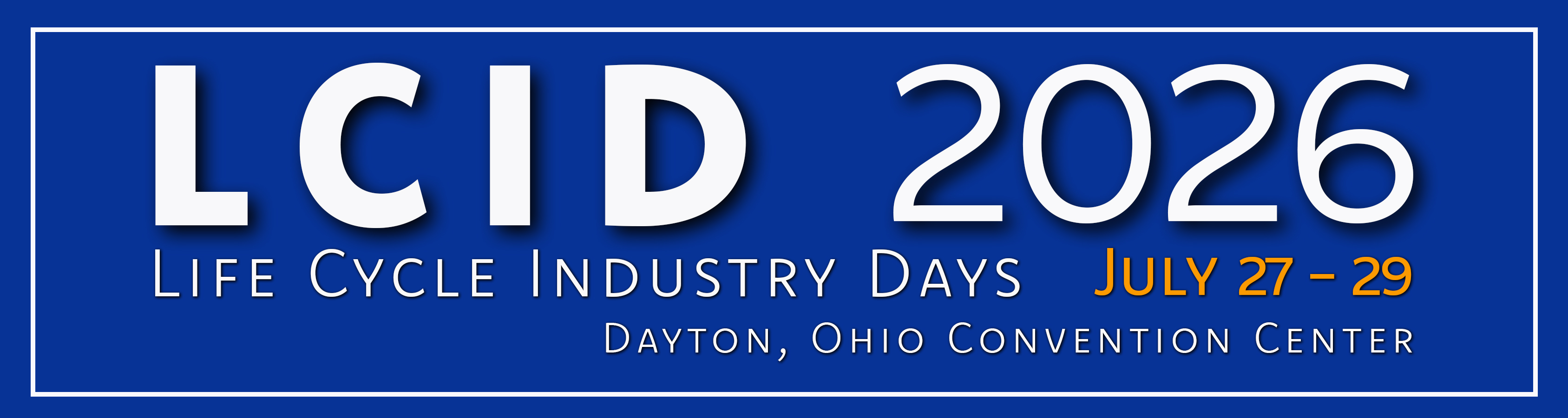
This is your prime opportunity to engage directly with Air Force leaders, industry innovators, and fellow Airmen. LCID is where partnerships are forged and the future of the enterprise is shaped. You'll gain exclusive insights from senior leaders and experience the next generation of aerospace technology at our dynamic industry expo.

The Los Angeles Digital Government Summit is where innovation meets impact!
Bringing together the brightest minds in state and local government, this summit empowers public-sector leaders to explore cutting-edge technologies, modernize operations, and solve pressing challenges. From cybersecurity and AI to data governance and digital service delivery, sessions are designed to spark insight, foster collaboration, and accelerate real-world results. Whether you're shaping strategy or implementing solutions, the Summit delivers valuable peer connections and actionable guidance to help move your mission forward.
Open to Public Sector only.

Delivering a seamless customer experience remains a top priority for federal agencies as expectations continue to evolve across citizens, employees and mission partners. What strategies are proving most effective in 2026, and how are agencies using data, AI and digital services to improve engagement, measure success and shape the future of customer experience?
Join this webinar to hear valuable insights from leading federal and industry CX experts:
- Janet Pence, Director of CBP Experience, Office of the Commissioner, Customs and Border Protection
- Barbara Morton, Deputy Chief Veteran Experience Officer, Department of Veterans Affairs
- Courtney Kay-Decker, Chief Taxpayer Experience Officer, IRS
- Brian Pancia, Senior Solutions Client Partner, Public Sector, Digital Experience, Verizon Business Group
- Victoria Calvert, Senior Manager, Federal Civilian, Cloudflare
- Moderator: Luke McCormack, Host of the Federal Executive Forum
Panelists also will share lessons learned, challenges and solutions, and a vision for the future.

Why Public Sector Leaders Are Coming to Erie
The Erie Summit is designed to address real-world public sector priorities, including protecting critical services, modernizing legacy environments, meeting compliance requirements, and preparing for AI-driven threats. You’ll hear directly from leaders and solution experts focused on practical strategies that support planning and investment decisions.
- Future-focused keynotes on public sector cyber priorities
- Practical discussions on modernization, resilience, and Zero Trust
- Partner solutions aligned to real-world public sector use cases
- Time with peers who are actively planning and investing
- Built-in networking designed to turn conversations into next steps
Summit Focus Areas
- AI in Cybersecurity
- Access Control and Identity
- Data Loss Prevention
- IT Modernization
- Zero Trust Strategy and Execution
- Threat Detection and Response
- Governance, Risk, and Compliance
Who Should Attend
Built for Public Sector and SLED Teams
- Public sector risk, compliance, and governance leaders
- State IT and Security leadership
- County and municipal CIOs, CISOs, IT Directors
- K-12 and Higher Education IT and Security teams
- Technology decision-makers supporting modernization initiatives
What Makes This Different
A Summit Built Around Real Conversations
This isn’t a trade show floor. The Erie Summit is structured to keep partner solutions connected to the challenges public sector teams are solving right now, with time and space for meaningful, peer-level conversations.
- Partner solutions, front and center: See how leading technologies align to public sector needs
- Decision-maker access: Meet leaders actively planning, modernizing, and investing
- Multi-day experience: Keynotes plus time for networking, discussion, and entertainment

In the seven years since the establishment of the U.S. Space Force, the Department of Defense has worked to prioritize space as a domain with as much weight and consequence as its other principle areas of responsibility. The Potomac Officers Club’s 2026 Air and Space Summit is paying tribute to this with the inclusion of USSF alongside the U.S. Air Force for its latest GovCon conference. Top leaders from both service branches will participate in engrossing dialog with industry’s finest executives for a packed day of keynote addresses, panel conversations and non-stop networking.
Sessions will explore how to bring in advanced technologies to stay ahead in the air and space domains and the strategies leaders are devising to combat new, ever-growing challenges.
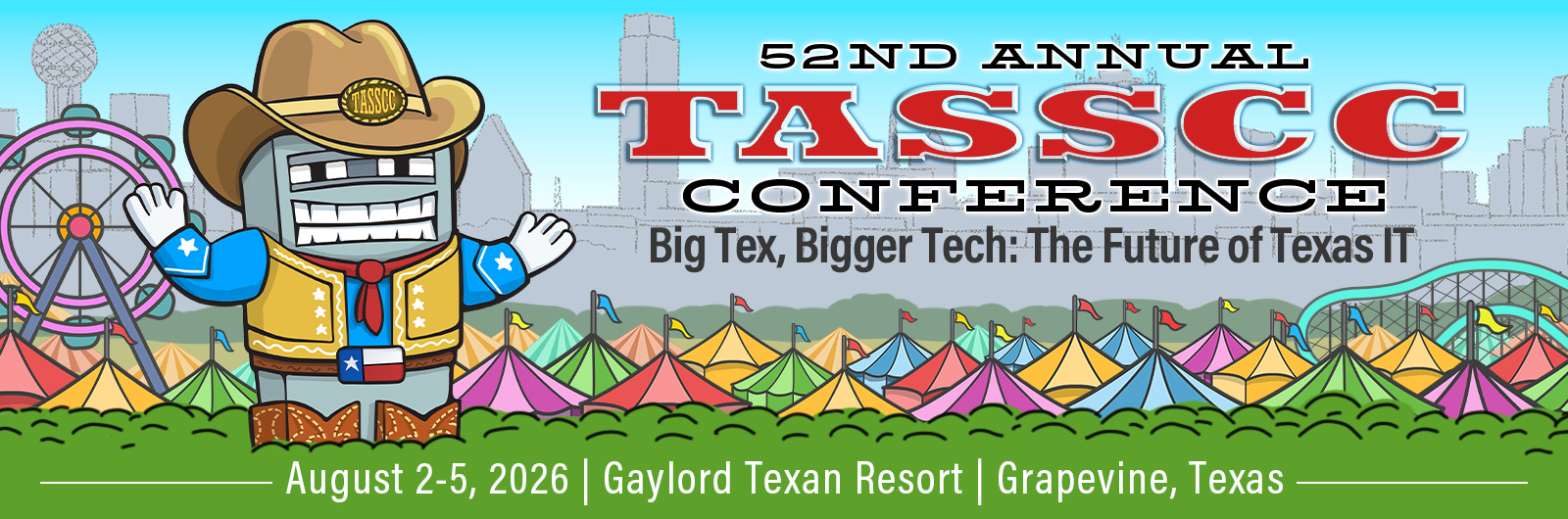
Welcome to the 2026 TASSCC Annual Conference. This year our conference will celebrate the TASSCC community and encourage collaboration between our agencies and our industry partners.
The TASSCC Annual Conference is Texas’s premier event for state IT leaders, partnering to advance education and networking among professionals supporting information technology for Texas public sector and higher education.
Last year’s event welcomed over 850 attendees, including 350+ government sector employees.
The 52nd Annual TASSCC Conference celebrates the spirit of Texas IT innovation with the theme “Big Tex, Bigger Tech: The Future of Texas IT.” Bringing together technology leaders, public sector professionals, and industry experts, this conference will explore the emerging trends, transformative technologies, and forward-thinking strategies shaping the future of IT across Texas. Hosted in the home of the iconic Texas State Fair, attendees will gain valuable insights, build meaningful connections, and discover how innovation is driving smarter, more connected communities for years to come.
Cyber attacks and data breaches are on the rise and continue to pose serious threats to our digital economy. Many are aware of cyber threats from human sources, but not many are talking about the security threat posed with unmanaged autonomous AI agents.
In response, state and local agencies are looking to
incorporate controls for AI into their cybersecurity measures.
According to the Code for America assessment, almost all 50 states have initiated pilot programs for a wide range of programs, with leaders like New Jersey and Pennsylvania operating AI at scale. But those governments continue to grapple with legacy system modernization and data cleanup, which are critical to ensure AI tools function securely and accurately without exposing siloed information.
Join us as thought leaders from government and industry share their insights in confronting AI-powered threats by seeking to harness AI tools into their existing and future cybersecurity programs.
Learning Objectives:
- Understand the nature of the cyber threats your agency faces and which ones are using AI to find weaknesses
- Review the steps to take a pilot project and replicate it at scale across your agency
- Evaluate your legacy system modernization and data cleanup programs to identify where AI tools can streamline processes and cut costs
- Outline the ways other state and local agencies have addressed these challenges
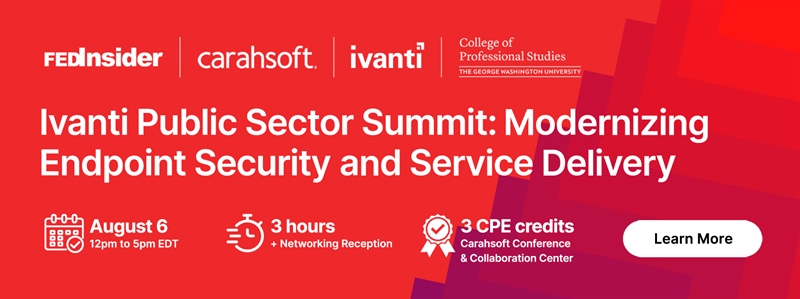
Ivanti, Carahsoft and FedInsider are bringing together government and education IT and security leaders for the 2026 Ivanti Public Sector Summit, an in-person event focused on strategies and technologies to help modernize IT operations and strengthen cybersecurity across the public sector. Across government and education, organizations are navigating increasingly complex IT environments while supporting hybrid workforces, expanding digital services and defending against evolving cyber threats. This summit will bring together leaders from federal, state, local, defense and education sectors to share practical approaches for improving visibility, reducing operational burden and delivering secure, reliable technology services. |
Join your peers and industry experts for an afternoon of insightful discussions, fresh perspectives and real-world experiences. |
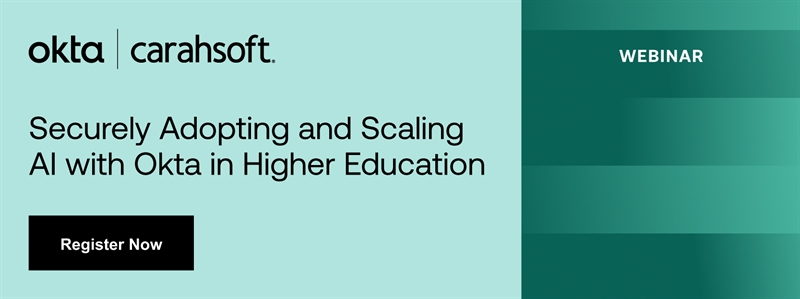
Join Okta for an exclusive virtual webinar focused on securely adopting and scaling agentic AI across higher education institutions. During this session, we'll dive into practical frameworks for managing decentralized campus risk, mapping shadow AI and measuring real ROI. Learn how to address complex identity challenges, govern access to AI applications and enable innovation without compromising security. Agenda:
You'll Learn About:
Space is limited, so be sure to reserve your spot today! |
Public sector organizations are operating in an increasingly complex environment shaped by evolving cyber threats, aging infrastructure, workforce shortages and growing expectations for modern digital services.
AI-driven attacks are expanding the threat landscape while legacy systems and fragmented data make it harder for agencies and institutions to respond quickly. At the same time, constituents, staff and students expect faster, more intuitive services similar to what they experience in the private sector.
To keep pace, government and education organizations are modernizing IT operations, strengthening endpoint security and adopting automation and AI to improve both cybersecurity and service delivery.
The Ivanti Public Sector Summit brings together leaders from federal, defense, state and local government, education and industry to discuss practical strategies for securing endpoints, modernizing IT service management and delivering trusted digital services.
Learning Objectives:
- Explain how modernization initiatives help agencies address evolving cybersecurity threats.
- Evaluate strategies for improving coordination between IT and security teams.
- Identify best practices for securing communications in classified and tactical environments.
- Describe key outcomes of effective vulnerability and patch management programs.
- Assess how AI and automation can improve IT service management and service delivery.

The National Homeland Security Conference brings together professionals in Homeland Security, Law Enforcement, Fire and Emergency Management. They include officials in federal agencies, nonprofit agencies, business owners, universities and decision makers who attend to learn about emerging trends in homeland security and see the new equipment and technology available to support their mission. Last year's conference was ground breaking for exhibitors and attendees. #NHSC2026 at the Kentucky International Convention Center promises to deliver another record breaking experience. The early bird registration rate is $700. After May 29th, the rate is $775! Registration closes on July 10th.
As agencies move to implement AI throughout their organizations, most are finding their AI efforts disrupted by fragmented, low-quality, or inaccessible data. This is a problem government shares with the private sector – a recent survey found that 79% of respondents said their AI initiatives are being hindered by limited access to data across environments.
These are not new problems for the government. There are still issues with data fragmentation and silos, poor data quality, complexities in applying governance and security requirements, and technical debt – legacy systems aren’t designed for modern analytics needs. And. of course, the pace of data generation continues to accelerate, adding to the pressure to clean and restructure massive numbers of datasets. That recent survey found that 60% of AI projects may be abandoned due to poor data readiness.
Learning Objectives:
- Outline the particular challenges in data readiness faced by your agency
- Delineate the steps to address those challenges, including prioritization and resource allocation
- Establish metrics to measure improvements in data quality so your agency datasets can be used by AI tools to produce trusted solutions

There is widespread recognition in federal agencies that they face increasingly sophisticated AI-driven threats. At the same time, agencies must also contend with evolving compliance mandates and shrinking budgets.
To simultaneously protect missions, ensure compliance, and align with federal efficiency and budget goals, agencies need to adopt modern, compliance-aligned endpoint detection and response (EDR) security strategies that enable full, real-time endpoint visibility while reducing false positives and preventing cost creep.
Join us as thought leaders from government and industry share their expertise, their experiences, and their suggestions for harnessing the power of AI to provide noticeable improvements to internal operations while improving security and opening up opportunities for new and expanded services to their constituencies.
Agencies throughout state, local, territorial, and tribal governments are being encouraged to incorporate artificial intelligence (AI) into their everyday operations, to streamline processes, modernize outdated systems, and strengthen cybersecurity defenses. Using AI is viewed as one promising way to deal with shrinking budgets and increased demand for services by citizens.
This three-day event addresses key issues that agencies must contend with in ensuring that investment in AI generates maximum benefit.
Learning Objectives:
- Outline the capabilities of AI management and compliance platforms and match them to the needs of your agency
- Delineate the use of the platforms to maintain auditability and traceability
- Understand how these platforms can guard against “shadow AI,” unauthorized use of AI within the agency
- Identify available AI tools to determine which best fit the security needs of your agency
- Review ways to integrate AI cybersecurity into existing defenses
- Understand the nature and magnitude of the threats posed by AI-empowered attacks
- Delineate places in your agency’s IT systems where AI can serve as a bridge between legacy systems and new services for citizens
- Establish priorities for tasks and processes that can be streamlined through the use of AI tools
- Outline metrics that can measure improvements, such as improved accuracy in testing, cost savings through reductions in outside labor costs (such as coding), and faster turnaround time in updating apps
State and local agencies are exploring how to incorporate artificial intelligence (AI) into their operations – as long as they observe their own state-level and any applicable federal-level regulations.
To meet these requirements, AI governance and compliance platforms help organizations manage, monitor, and enforce policies for safe, ethical, and legal use of AI, covering the entire lifecycle from development to deployment, by automating risk assessment, bias detection, and access control. These platforms centralize control, provide transparency, track data lineage, and automate auditing to build trust and prevent issues like unfair outcomes or data breaches.
Learning Objectives:
- Outline the capabilities of AI management and compliance platforms and match them to the needs of your agency
- Delineate the use of the platforms to maintain auditability and traceability
- Understand how these platforms can guard against “shadow AI,” unauthorized use of AI within the agency
Events Where We Are Exhibiting
The Los Angeles Digital Government Summit is where innovation meets impact!
Bringing together the brightest minds in state and local government, this summit empowers public-sector leaders to explore cutting-edge technologies, modernize operations, and solve pressing challenges. From cybersecurity and AI to data governance and digital service delivery, sessions are designed to spark insight, foster collaboration, and accelerate real-world results. Whether you're shaping strategy or implementing solutions, the Summit delivers valuable peer connections and actionable guidance to help move your mission forward.
Open to Public Sector only.
The Vermont Digital Government Summit is where innovation meets impact!
Bringing together the brightest minds in state and local government, this summit empowers public-sector leaders to explore cutting-edge technologies, modernize operations, and solve pressing challenges. From cybersecurity and AI to data governance and digital service delivery, sessions are designed to spark insight, foster collaboration, and accelerate real-world results. Whether you're shaping strategy or implementing solutions, the Summit delivers valuable peer connections and actionable guidance to help move your mission forward.
Open to Public Sector only.

TechNet Augusta 2026 gives participants the opportunity to examine and explore the intricacies of the cyber domain. With assistance from the U.S. Army Cyber Center of Excellence and industry experts, the conference is designed to open the lines of communication and facilitate networking, education and problem solving. Leaders and operators also discuss procurement challenges the military, government and industry face during a time of uncertain budgets and runaway technology advances.
The North Carolina Digital Government Summit is where innovation meets impact!
Bringing together the brightest minds in state and local government, this summit empowers public-sector leaders to explore cutting-edge technologies, modernize operations, and solve pressing challenges. From cybersecurity and AI to data governance and digital service delivery, sessions are designed to spark insight, foster collaboration, and accelerate real-world results. Whether you're shaping strategy or implementing solutions, the Summit delivers valuable peer connections and actionable guidance to help move your mission forward.
The Department of the Air Force Information Technology and Cyberpower Training and Education Event (DAFITC) will take place in Montgomery, AL from August 24-26, 2026.
This year, thousands of Air Force peers, along with private sector leaders in the IT and cyber security field convened to network, discuss, connect, and learn about the newest and most prevailing threats to our global networks and national defense. DAFITC 2026 is expected to featured 140+ breakouts, an exhibit hall with over 200 vendor booths, and over 4,000 attendees, speakers, and exhibitors.
Attendees will hear from leading voices in the public and private sectors, hearing a range of ideas, opinions, and assessments of the current state of all things cyber as well as insights into what the keys to future success might look like.

The California Government Innovation Summit is where innovation meets impact!
Bringing together the brightest minds in state and local government, this summit empowers public-sector leaders to explore cutting-edge technologies, modernize operations, and solve pressing challenges. From cybersecurity and AI to data governance and digital service delivery, sessions are designed to spark insight, foster collaboration, and accelerate real-world results. Whether you're shaping strategy or implementing solutions, the Summit delivers valuable peer connections and actionable guidance to help move your mission forward.

Co-hosted by AFCEA and INSA, the nation’s leading non-profit associations dedicated to public-private partnerships, the summit will bring together 2,200 leaders from government, academia, start-ups, and the defense industrial base for two days of technology-driven, mission-focused discussions.
Your registration and sponsorship don't just underwrite an event, they strengthen our mission and support the community we serve.
From a career fair and thought-provoking plenaries to breakout sessions, cutting-edge exhibits, and unmatched networking, the Summit is where connections spark ideas and partnerships that last. Registration opening Spring 2026!
The Colorado Digital Government Summit is where innovation meets impact!
Bringing together the brightest minds in state and local government, this summit empowers public-sector leaders to explore cutting-edge technologies, modernize operations, and solve pressing challenges. From cybersecurity and AI to data governance and digital service delivery, sessions are designed to spark insight, foster collaboration, and accelerate real-world results. Whether you're shaping strategy or implementing solutions, the Summit delivers valuable peer connections and actionable guidance to help move your mission forward.
Open to Public Sector only.

The Connecticut Digital Government Summit is where innovation meets impact!
Bringing together the brightest minds in state and local government, this summit empowers public-sector leaders to explore cutting-edge technologies, modernize operations, and solve pressing challenges. From cybersecurity and AI to data governance and digital service delivery, sessions are designed to spark insight, foster collaboration, and accelerate real-world results. Whether you're shaping strategy or implementing solutions, the Summit delivers valuable peer connections and actionable guidance to help move your mission forward.
Open to Public Sector only.
The Florida Public Sector Cybersecurity Summit is where government defends the future.
This public sector-focused event brings together IT security leaders, risk managers, and public officials to tackle the evolving cyber threats facing state and local government. Through expert-led sessions, peer exchange, and real-world case studies, attendees gain practical strategies to strengthen cyber resilience, protect critical infrastructure, and lead with confidence in an age of constant risk. Designed specifically for the public sector, this summit delivers insights you can act on and alliances you can trust!
The TribalNet Conference & Tradeshow is the annual gathering of the TribalHub community. It is not just another conference; it is an experience! This is one of the only events truly dedicated to Native American government, gaming, and health technology – with topics that are relevant to what is going on both nationally and locally. The attendees and vendors are open, engaged and ready to make valuable connections! In today’s world, it’s more essential than ever, for business leaders to utilize cutting-edge technologies and leadership strategies across all departments to create sustainable growth and success. The TribalNet Conference & Tradeshow is a great opportunity to take advantage of a growing network of resources, experience and industry connections, ensuring that enterprise and government leaders are in possession of the tools and information that they need to thrive in their industries.
What will you gain by attending?
- Valuable Connections with Vendor Partners and Industry Peers
- Opportunities for Collaboration with other Tribes
- Practical Tools for Business Growth
- Knowledge of the Latest Technology Tools and Resources
Each year, SC provides the leading technical program for the HPC community. The Program is designed to share best practices in all areas of high performance computing. Become a contributor and share your excellence. Presenting at SC is extremely rewarding.
Here’s your opportunity to meet and interact with industry, research organizations, universities, and startups joining us from across the globe. As an exhibitor, showcase your cutting-edge technologies, products, and services to thousands of attendees.
The Students@SC program offers a broad range of volunteer experiences, cluster competitions, and networking opportunities. Put your professional development into overdrive and identify the possibilities within the field of high performance computing.
Industry, academia, and government experts volunteer to design, build, and administer the cutting-edge SCinet infrastructure, providing internet connectivity for attendees and pushing the boundaries of network innovation through research and demos.
The Florida IT Leadership Forum is where tomorrow’s government leaders grow today.
This invitation-only gathering brings together state and local IT executives, emerging leaders, and visionary thinkers for candid conversations on the future of public-sector technology. Focused on leadership development, innovation, and strategy, the Forum goes beyond the tech to address the people, policies, and practices shaping digital government. Through peer exchange and practical sessions, participants gain the insights, relationships, and skills needed to lead their organizations and communities into the future.
For more information or to request an invitation, please contact Jennifer Caldwell.